Showing posts with label Non-fiction: narrative. Show all posts

Monday, 25 July 2011

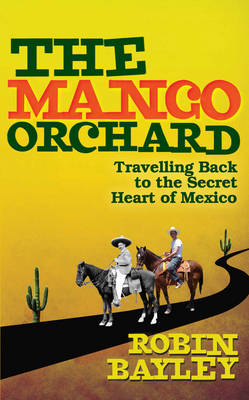
Book Review: The Mango Orchard by Robin Bayley


I remember the first time I had the feeling that somewhere, something was waiting for me, in a land I didn’t yet know.

So begins The Mango Orchard, Robin Bayley’s enthralling travel writing come family history adventure. At its heart lies an appreciation of the power of stories and storytelling. As a boy, Robin had listened enthralled as his grandmother told tales of Mexican adventures at the beginning of the twentieth century; of her father, Arthur ‘Arturo’ Greenhalgh, and his run-ins with bandits, bags of silver left beside a mango tree, and a narrow escape from the Mexican revolution. Like the best stories, these opened up new worlds of possibility to Robin, and posed unanswered questions. Were those bags of silver still there, hidden in the trunk of a mango tree? If Arturo had left in such a hurry, he must have left something of himself behind.

These stories stayed with him as he grew up and, when the opportunity of voluntary redundancy presented itself, he set out to follow in the footsteps of his great grandfather and discover the truth for himself. The Mango Orchard is a record of those travels, and the amazing discovery he makes in a small village in western Mexico. And soon the stories are turning full circle, driving new adventures, some even more amazing than the ones that started it all off.

The Mango Orchard is a compelling and readable tale that warms the heart and reminds us of the common humanity we share the world over. Bayley tells his parallel stories with wit and wide-eyed sense of adventure. He possesses an ear for dialogue and his writing captures the sounds and flavours of Latin American Spanish in a way that is easy to digest, yet gives the impression of being there in the midst of other languages and cultures.

The differences in culture are elucidated without Bayley needed to consciously express them; they come through in every word he writes, and in the situations he finds himself in. As he travels through New York, Guatemala, Colombia, and Venezuela, on route to Mexico, he encounters a series of situations and characters whose own stories and lives threaten to divert him from his quest. There’s the archetypal South American hotel that rents rooms to couples by the hour, and to tourists too poor to afford anywhere else by the night, in which Bayley finds himself lying awake to the sound of gunshot outside and a body landing on the roof above. There’s a wild drive in a ramshackle car that needs running repairs on a regular basis; a beautiful and mysterious Guatemalan girl with seemingly mystical powers. Families take him in with astounding generosity that is unimaginable in the UK.

But he presses on, and suddenly the mystery resolves itself. Towards the end, a conversation takes place between Robin Bayley, and one of his newly found relatives:

‘You know,’ I say, my arm round his shoulder, ‘the fantastic thing about being here is not only that you are all family, but that you’re all such great people too.’
‘Yes, but somos familia.’ We’re family.
‘I know that, but what I’m trying to say is that as well as that, you’re Buena gente.’ Good people.
He shakes his head in incomprehension. ‘Somos familia.’
Finally I see his point. We are family, punto. Nothing else matters.

More than anything else, this dialogue sums up the amazing journey of discovery that makes up The Mango Orchard. What is family? What does it mean to have a family? And how far will you travel in search of a family. These are the questions that are raised on every page, and tied throughout are the stories these families tell.


At times, character development is a bit slight and there are depths of the story that are not mined as fully as one might like. The critical reader may feel they wanted more background on events and clearer explanations of some of the events that take place, particularly surrounding Arturo's involvement in the Revolution. However, these are minor concerns and the overriding impression of The Mango Orchard is as a compelling and heartfelt expedition, a powerful case for valuing stories and storytelling,  and an amazing tale that demonstrates that the truth is often far stranger and more rewarding than fiction.

The Mango Orchard was first published by Preface, an imprint of Random House, in 2010. Edition shown is this first Hardback edition, which has since been replaced by a paperback version, published by Arrow Books, another imprint of Random House, in 2011. ISBN (HB) 9781848092235, (PB) 9781848092242. 303pp

Tuesday, 1 June 2010

Book Review: The Tall Man: Death and Life on Palm Island by Chloe Hooper

Read: May 2010


Palm Island, November 2004. A 36 year old Aboriginal man, Cameron Doomadgee, is arrested for swearing at a police officer. He is drunk, and as they arrive at the station he strikes Senior Sergeant Christopher Hurley in the face.

45 minutes later Cameron Doomadgee is dead, his liver cleaved in two as you might see after a fatal car crash. The police say he fell on a step but others disagree. A week later there is a riot during which the police station is burnt to the ground and Hurley’s residence with it. A relief team is sent in and Hurley goes into hiding. But the case doesn’t go away. An inquest is launched, then a criminal trial. It’s the first time in Australian history that a police officer has been brought before the law to answer for the death of an Aboriginal prisoner in their care. In the process the trial comes to embody all of the hurt and guilt and prejudice that underline relations between native and white Australia.

The Tall Man is the story of what happened on that fateful morning, and all that followed. It is about Palm Island, a tropical ‘paradise’ off the Queensland coast, and the horrendous legacy of disadvantage it has been bequeathed by history. It is about Hurley and other frontier police officers, and the communities they serve. It is about Australia at the beginning of the twenty-first century. Fusing personal story with anthropology, history with mythology, and the literary acumen of a novelist with the clear eye of a reputable journalist, Chloe Hooper has written a stunning work of narrative non-fiction.  In the pantheon of the true crime genre it sits right up there with Truman Capote’s In Cold Blood.

Like the Holcomb of Capote’s work, Palm Island is an ‘out there’ sort of place, easily, and perhaps conveniently, forgotten. For much of the twentieth century it was used as a sort of island gulag reserve and missionary for Aboriginals who digressed from white rule – such offences as speaking a native language, getting pregnant to a white man, disruption or being born of mixed heritage. Although this ceased in the mid-1980s and the island now has semblance of self-rule, the impact of these ‘stolen generations’ has led to social breakdown of a quite startling proportions. The unemployment rate is somewhere around the 90% mark, incidences of alcoholism and domestic abuse are rife. When Chloe Hooper – middle-class suburbanite from Melbourne who had spent much of her twenties living abroad and “knew very little about indigenous Australia” – arrived there she describes herself as feeling “incandescently white.” Yet one of the most notable, and laudable, aspects of The Tall Man is that it is primarily about people rather than issues. Hooper gives a human face to statistics and couches much of the book in personal accounts. At one point, reflecting on the fact that Hurley and Doomadgee were each 36 years old on the day they met, she realises that if one were to deduce their life expectancy based on that of their wider communities’, Cameron had only another decade to live whereas Hurley had half his life ahead of him.

At its heart, The Tall Man is a personal journey – for both Hooper and the reader – into the heart of darkness in Australia, and an investigation of the uncomfortable troubles that lurk there. She is the perfect sort of narrator: an outsider wherever she goes who is determined to understand the wider situation and has the skill to get people to open up. Her approach is an interesting one. Neither journalist nor anthropologist, she is not content to remain on the sidelines, to look but not touch. Over the course of the book she meets people from all sides and grows close to Cameron’s family. Although originally brought in by the lawyer representing the Doomadgee family, and feeling great solidarity for them and their cause, she doesn’t let this inherent bias cloud her reportage and remains scrupulously fair to all involved. This is particularly noticeable where Christopher Hurley is concerned. An enigmatic giant standing at 6’7”, he is presented as an ambitious man who has devoted his career to working in some of the most remote and difficult communities. Hooper travels to these Torres Strait and Gulf of Carpentaria communities and meets people who describe him fondly, and tell stories about him setting up local sports clubs and taking children on trips. She meets a prominent Aboriginal activist who describes an early situation in which Hurley was confronted by his inherent racism and decided to change. Yet others who knew Hurley talk of a megalomaniac policeman with a temper, ready and willing to administer “frontier justice” should anyone transgress his authority. Hooper talks to people who celebrate this sort of no-nonsense policing as the only way to get by in hard, hard deep north, but others describe him as a bully. One of the most interesting aspects of The Tall Man is that the reader quickly comes to perceive that, while race may have been a driving factor in the public response to the case, Doomadgee’s death may not have been racially motivated at all.

It is just one of the many factors that muddy the water and leads directly to one of the many seems that run through The Tall Man: an investigation of frontier policing, and the contradictions at its heart. Hooper quotes Norman Mailer and George Orwell amongst others, and reflects upon the difficult questions that arise when one person or small group of people holds all the legal power in a community. Particularly a community as difficult as Palm Island.


“Can you step into this dysfunction and desperation and not be corrupted in some way? In a community of extreme violence, are you, too, forced to be violent? If you are despised, as the police are, might you not feel the need to be despicable sometimes? Could anyone not be overcome by “the growing regrets, the longing to escape, the powerless disgust, the surrender, the hate?””

While Hurley emerges as a multi-faceted and complex character about whom we suspend our judgement, the Queensland Police Union does not. Their behaviour, as told by Hooper, is a scandalous mix of blind ‘defend our own’ attitudes with menacing threats should the courts find against Hurley. The chapter on a rally they held in support of Hurley makes for incredibly disconcerting reading.

Indeed, The Tall Man is packed with affecting moments of all sorts. Scenes to make one angry with impotent rage, disgusted, uncomfortable or sad. But in-between these, there are passages of great humanity: a day in church with Doomadgee’s sister Elizabeth, a letter from an officer who doesn’t support the Police Union’s response. There’s a second of eye contact in court between Hooper and Hurley, the funeral of Cameron’s son who kills himself two years after his father’s death. One of the most encompassing of these is a comparison between two witnesses at the trial which comes to represent so much of the racial divide. First there is Hurley, “like TE Lawrence back from the wilderness, smooth and upstanding at the London Club.” And against him a resident of Palm Island, who was there when Doomadgee was arrested that November morning:

“Hunched slightly in her faded clothes, rolls of fat on her back, Gladys Nugent stood for everything white Australia doesn’t want to know about black Australia. She was alcoholic, diabetic, and she had heart trouble. She told the court about drinking all day and night, being bashed, binging on methylated spirits; about her partner, Roy, being in jail; about her nephew Patrick sniffing petrol and hanging himself. She had a plain, obstinate dignity. And fleetingly it was not clear who was more abject here – Gladys or the lawyer paid to hector her.”

Ostensibly about the death of Cameron Doomadgee and the case that followed, it is really about what this case says about Australia at the beginning of the twenty-first century. What Chloe Hooper finds is a nuanced and complex situation in which there are few straight-forward answers and none of them are particularly palatable. Like the case at its heart, The Tall Man is full of contradiction and inversion. Hooper seeks to understand without judgement, and to reflect without distortion. It is a thoroughly researched and important work, but one that reads like a novel. The Tall Man presents a passionate, engaging, and incredibly moving account of life on Palm Island and it is humanity that shines through brightest, even – or perhaps particularly – amidst the most vociferous outrage.

“I had wanted to know more about my country and now I did”, Hooper reflects at the end. “Now I knew more than I wanted to.”

Vintage Books, January 2010, 9780099520764, 258pp

8.5 out of 10