Showing posts with label Book Review. Show all posts

Friday, 29 May 2015

Wilding the Tame: Two Encounters with Wolves

Wolf's Child, Wild Works in association with Norfolk and Norwich Festival, Felbrigg Hall
The Wolf Border by Sarah Hall (Faber, 2015)

Two (artistic) encounters with wolves over the last couple of weeks have got me thinking about our relationship with the wild in ourselves and in nature, and whether there is a difference between the tame, and the domesticated. And just how easy it is to romanticise the wild from an urban lifestyle, without really experiencing it as it is.

Wild Works new site-specific immersive story, produced at Felbrigg Hall in partnership with Norfolk and Norwich Festival, takes us on a fairy-tale adventure that mirrors the Greek myth of Calisto - the nymph turned bear - and the unusual life of Peter the Wild Boy, an eighteenth century boy found living wild in the woods of Northern Germany and brought back to live in the UK.This is what Wild Works do: they set up camp somewhere, meet people, uncover stories, and produce theatre that has that place and those stories at their heart.

In this one, we begin with a warning: do not stray from the middle of the paths - wolves are about, and our safety cannot be guaranteed. Nor can it be for Rowan, mute orphan and heroine of this show, who plays her wobbly fear with strained abandon. We first meet her amid the orphanage of Mother, a prim and austere woman who has dedicated her life to creating civilised order and ladylike manners in a manicured house on the edge of a dark forest. But Mother likes to scare her orphans into propriety. and when Rowan is sent out into the woods with a shotgun, she begins an odyssey that takes in an erotic encounter with some sort of wild stag-man, a pack of wolves, a child, and an inter-generational conflict with Mother and her harem of order.

We're guided around the forest by a murder of crows: they narrate the story and entertain us on the long walks between scenes. The female crow, with her esturine squarking runs away with the show, so fantastically does she capture the playful inquisitive intelligence of the crow.

There are other triumphs, too - a puppet of a young daughter taking her first steps in the wolf pack; the image of mother riding upright on her horse before the great grandeur of National Trust's Felbrigg Hall; and the way that an hour in we realise we have left the path and are totally lost in the woods with no idea which direction lies civilisation. The sun has sunk, the sky is a blueish grey, lighter than the treetops shadowed against it. There are candles lighting our path, sometimes a blue tinge to our destination, but either side is darkness and unknown.

If there is a criticism, it is that of many large-scale site specific works - the shepherding of an audience takes time and, for all the efforts of the crows, breaks the intensity of the story. And while the story they tell feels wild and unrestrained, following a line of theatre goers doesn't. I found myself taken out of the story too often to fully immerse, which after the intensity of A Girl is a Half-formed Thing the night before, was a shame.

There's also a sense of romanticising the wildness. This feels like a story for an urban arts audience. Perhaps I just wanted some proper danger and uncertainty! But its an amazing spectacle nonetheless.

What Sarah Hall does in The Wolf Border is simultaneously less dramatic, and more creative. The novel is about transition and change, mutability, and an interaction between the tame and the wild, voluntary, changeable, permeable. Rather than looking to a mythical past for her story, she sets it the UK today, telling a story of rewilding a tame landscape as the old-order begins to break-down, and wild new possibilities open up in a newly independent Scotland. It's a cunning tale from one of the wildest of UK writers: Sarah Hall's oevre is packed with tales of altered landscapes and characters longing to throw off the shackles of conventional life for something altogether more elemental, physical, less governed by the mind.

The heroine here is Rachel Caine, refugee from a bohemian mother, who has for years been working as a wolf expert in the US. But her life is in transition, and following her mothers death and an unexpected pregnancy, she decides to accept the offer of an Earl who has an eccentric plan to reintroduce the wolf to the UK landscape on his vast estate. In language that is scented to the earthy, metallic Cumbrian landscape, we almost feel as though Rachel is some sort of shamen figure, totemically running free alongside the pack, guiding them towards their natural home. If there is a philosophy underpinning this book, it is that we cannot escape our nature, that we are all part tame, part wild and both parts will get us in the end.

This is reflected in the narrative of Scottish Independence, which sits alongside the main plot. But what starts as a naturalistic presentation of the UK over the summer of 2014, begins to become altered as the vote goes the other way, and the public schoolboy Westminster power-base is challenged. The portrait of Scotland is slightly one-dimensional; a rugged antithesis of ennobled England. But the border is both physical and metaphorical, a transition of mindset as well as of landscape.

Sarah Hall's writing is swift and enthralling, the plot sucks you in and her very real characters enchant. She's one of my favourite British novelists, and her perspective that sits somewhere between naturalist and farmer is an unusual one in the often too bland middle-England literature. There's much familiar about this tale, in setting and atmosphere. It feels like Haweswater meets The Carhullan Army, and I flew through it in a couple of days - very quick for me! - starting on a train from Lancaster to London as I mourned the fading Cumbrian landscape behind me. There's a thrill in the wild, it calls to us like a romantic longling for something we feel we've lost. Something human, though. Governed, by our fantasies and imaginings. Wolf's Child taps right into this, and is limited by it. But The Wolf Border takes a step further, exposing that longing as an empty misunderstanding, and presenting a wilderness that is. It just is. That's Sarah /Hall's brilliance.

Thursday, 3 October 2013

Guest Book Review: Maggot Moon by Sally Gardener

Each year I have the pleasure of working with a group of readers to collectively select the books that will feature in a reading programme, Summer Reads. Between August 2013 and January 2014, the Readers' Circle will work through a longlist of more than 150 books to find the 6 titles that we fall in love with and want to recommend to other readers. And throughout that period I'll be posting some of the reviews here on Books, Time and Silence. 
*Thanks to the publisher for providing review copies of this book.

Guest Review by Pearl Crossfield

Maggot Moon is a young adult novel that has the potential to appeal to a wide range of ages. Sally Gardner dedicates her book to 'the dreamers / Overlooked at school /  Never won prizes - you who will own tomorrow'  and this pretty well sums up both the protagonist of the story and the plot line.  Standish Treadwell is a teenager who appears to suffer from dyslexia, who  'can’t read / can’t write' and is bullied at school.  For him the words on the blackboard are 'just circus horses dancing up and down', they mean nothing and he prefers his daydreaming life because it’s better than being 'worried sick' all the time. Yet  Standish is clever, has imagination and courage and eventually achieves a great victory, albeit a bitter-sweet one.

The drawings scattered throughout the pages feature the life cycle of the fly and the death of a rat.  The drawings are cartoon-like and offer a skillful way of holding a distracted children’s attention. The images tell a story of death and regeneration, a life cycle explored through decaying matter and the food chain. Sally Gardner and illustrator Julian Crouch cleverly draw a parallel with an infestation of maggots both in the natural world and in the society the characters are living in, and alludes to the title and the somber themes of the book.

Any reader no matter what age could appreciate this book on several different levels.  It is imaginative, with a clever use of language, Standish may not be able to read and write but he has a broad vocabulary, saying 'I collect words - they are sweets in the mouth of sound'.  He can use words in a humorous way too, when describing a teacher he says, 'Never would I have thought that the hard boiled Miss Philips had such a soft, sweet centre'.  Despite the short, tight chapters (some only a paragraph), and the humour, it is not a light read at all.  It is a fable, but a rather bleak and grim one. We never quite get a sense of the setting and I found myself wondering whether the characters were perhaps living in an alternative history, a kind of post World War Two totalitarian regime. There could also be historical parallels drawn here with the deception of the moon landing, since there have been conspiracy theories about moon landings, hoaxes supposedly staged by NASA. I’m sure that each reader will create their own idea of this world but you probably need to be older to appreciate the historical realism, and to see what Standish, as first person narrator, does not see at first, the gap between the appearance and the reality.  The characterization is good, particularly Standish, and despite his oddness and the weirdness surrounding him he becomes a rounded, real person, a “crazy brave muddle” who we want to find freedom for himself and his friends and family.

This is an unusual book, a quick read but a thought provoking one.

Maggot Moon was published by Hot Key Books in 2013. Edition shown is paperback edition, ISBN 9781471400445, 279pp

Pearl Crossfield has recently retired after a career working for an Insurance Company and Local Government.  She can’t remember a time when she did not enjoy reading and recently studied Literature part-time with the Open University.  After all, there's little better than being able to discuss books with other like-minded people!

Wednesday, 15 May 2013

Book Review: This Isn't The Sort Of Thing That Happens To Someone Like You by Jon McGregor

'You take a breath and swim, fiercely, lunging through the water, blinking against the salt sting, heaving for air, and there's a feeling running up and down the backs of your legs like muscles being stretched tight but you keep swimming because you'll be there soon, climbing out, pulling yourself back on to solid ground, and you keep swimming because there's a chance that the current has been pushing you away from the shore, and you keep swimming because this isn't the sort of thing that happens to someone like you, you're a good swimmer, you're young, and healthy, and the rocks aren't really all that far away and it shouldn't take long to get there and there isn't anything else you can do but now there's a pounding sensation in your head and a reddish blur in your eyes and a heavy pain in your chest as though the weight of all that water is pressing against your lungs and you can't take in enough air and so you stop again, for a moment, just to catch your breath.'
'We Wave And Call'

This Isn't The Sort Of Thing That Happens To Someone Like You could be the title of any of Jon McGregor's four published books. He's a writer interested in moments that change lives and the legacy of these upon his characters. His debut, If Nobody Speaks of Remarkable Things, took this concept literally, fusing narratives charting the effects of a single incident and using them to create tension as another narrative built to that crescendo moment. Even the Dogs - his Dublin IMPAC Prize winning novel about a group of drug addicts watching the final journey of one of their own - is all about the after-effects of these single moments. McGregor is a master of writing voice, particularly those of the dispossessed. He captures the humanity, the universal, without romanticising. His characters narrate with the hesitant, repetitive, circuitry, unfinished speech we all use. And his prose is vibrant, playful, energetic, and alive.

The thirty stories collected in This Isn't The Sort Of Thing That Happens To Someone Like You have been written over the last decade: its a summary of his career to date as he grows from a talented wordsmith and storyteller to one of our foremost writers (and, in his own words, 'Britain's second best short story writer' - a reference to 'If It Keeps On Raining' and 'Wires' finishing as runner up in the BBC National Short Story Competition for 2010 and 2011 respectively), challenging conventions and forms of storytelling, pushing boundaries all the time with how words on a page can be used to communicate something. McGregor has written of his appreciation of David Foster Wallace and you can feel his influence here. This Isn't The Sort Of Thing That Happens To Someone Like You is funny, challenging, scary, affirming, and much more besides. It is very good indeed.

The things you don't see happening to someone like you begin with an older couple, arguing gently over the washing up. They aren't all dramatic. A man builds a tree house by the river, in preparation for a coming flood. A sugar beet crashes through the windscreen of a young woman. Fighter jets fly overhead as a war looms. Crime, political tensions, environmental Armageddon, accidents, stagnation in life. 

They are all set in the vast flat landscapes of the Fen's, where sky and horizons blend and long flat roads stretch into the distance. Its farming landscape, traditionally mined in literature for themes of memory and forgetting. These are stories that explore the psychology of life in a flat reclaimed landscape, stolen from the sea, and where one of the things we don't see coming may just be its return to the sea. All the while, these places - Upwell, Irby in the Marsh, Messingham, Lincoln etc - feel as if they are being inscribed into stone against the forgetting of the future.


View This Isn't The Sort Of Thing That Happens To Someone Like You - Jon McGregor in a larger map

These stories are born of cycling the landscapes. Their settings correspond with their imaginings. The landscapes are both incidental and central to providing cohesion to the collection. These landscapes are perhaps best explored in 'In Winter the Sky' where a woman's poems about the colour and atmosphere of the sky are set alongside a story about burying the past in the soil, only for floodwaters to bring it back to the surface years later.

'People are not drawn here by the romantic sound of the place.
People don't much come here at all, and so the landscape
remains empty and
retains its beauty and

the beauty of this place is not in the names but the shapes
the flatness    /    hugeness    /    completeness of the landscape.
Only what is beneath the surface of the earth is hidden
(and sometimes not even that)
and everything else is made visible beneath the sky.'

One has a strange experience reading many of the stories here. McGregor experiments with different narrative styles - poetry alongside prose, stories told through a surveillance report or a redacted security document - and one goes into these with a slight sense of trepidation. Yet it is these stories that are some of the most rewarding. For they challenge ones sense of a story, of what a story is about, of why a story is told.

If there is a criticism, it is that there are perhaps a few too many stories here. The three experiments with form, the five or six most engaging stories - 'Wires' and 'If It Keeps On Raining', 'Which Reminded Her Later', 'We Wave and Call' - and a few of the shorter entries would have been more than enough. Between six and ten fewer stories would have made it one of the finest collections I have encountered.

Jon McGregor is my favourite contemporary British writer. It was delightful, therefore, to see this collection selected from a longlist of 116 books, to feature in the Summer Reads programme I run. Six great books selected by readers for readers. Books that inspire adventures and expand horizons. If you're looking for tried and tested books, these six come with a readers stamp of approval and a personal recommendation: we fell in love with these books and thought you might too.

For an extract from ‘Wires’ click here
For audio visual content of Jon McGregor reading and discussing his work, click here
And to see a fantastic event with Jon McGregor and Sarah Hall in Norwich in July, click here

This Isn't The Sort Of Thing That Happens To Someone Like You was first published by Bloomsbury in 2012. The paperback edition, published in 2013 (ISBN: 9781408830383, 262pp) is available now.

Monday, 25 July 2011

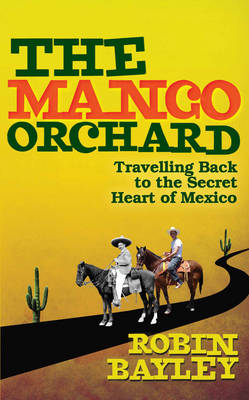
Book Review: The Mango Orchard by Robin Bayley


I remember the first time I had the feeling that somewhere, something was waiting for me, in a land I didn’t yet know.

So begins The Mango Orchard, Robin Bayley’s enthralling travel writing come family history adventure. At its heart lies an appreciation of the power of stories and storytelling. As a boy, Robin had listened enthralled as his grandmother told tales of Mexican adventures at the beginning of the twentieth century; of her father, Arthur ‘Arturo’ Greenhalgh, and his run-ins with bandits, bags of silver left beside a mango tree, and a narrow escape from the Mexican revolution. Like the best stories, these opened up new worlds of possibility to Robin, and posed unanswered questions. Were those bags of silver still there, hidden in the trunk of a mango tree? If Arturo had left in such a hurry, he must have left something of himself behind.

These stories stayed with him as he grew up and, when the opportunity of voluntary redundancy presented itself, he set out to follow in the footsteps of his great grandfather and discover the truth for himself. The Mango Orchard is a record of those travels, and the amazing discovery he makes in a small village in western Mexico. And soon the stories are turning full circle, driving new adventures, some even more amazing than the ones that started it all off.

The Mango Orchard is a compelling and readable tale that warms the heart and reminds us of the common humanity we share the world over. Bayley tells his parallel stories with wit and wide-eyed sense of adventure. He possesses an ear for dialogue and his writing captures the sounds and flavours of Latin American Spanish in a way that is easy to digest, yet gives the impression of being there in the midst of other languages and cultures.

The differences in culture are elucidated without Bayley needed to consciously express them; they come through in every word he writes, and in the situations he finds himself in. As he travels through New York, Guatemala, Colombia, and Venezuela, on route to Mexico, he encounters a series of situations and characters whose own stories and lives threaten to divert him from his quest. There’s the archetypal South American hotel that rents rooms to couples by the hour, and to tourists too poor to afford anywhere else by the night, in which Bayley finds himself lying awake to the sound of gunshot outside and a body landing on the roof above. There’s a wild drive in a ramshackle car that needs running repairs on a regular basis; a beautiful and mysterious Guatemalan girl with seemingly mystical powers. Families take him in with astounding generosity that is unimaginable in the UK.

But he presses on, and suddenly the mystery resolves itself. Towards the end, a conversation takes place between Robin Bayley, and one of his newly found relatives:

‘You know,’ I say, my arm round his shoulder, ‘the fantastic thing about being here is not only that you are all family, but that you’re all such great people too.’
‘Yes, but somos familia.’ We’re family.
‘I know that, but what I’m trying to say is that as well as that, you’re Buena gente.’ Good people.
He shakes his head in incomprehension. ‘Somos familia.’
Finally I see his point. We are family, punto. Nothing else matters.

More than anything else, this dialogue sums up the amazing journey of discovery that makes up The Mango Orchard. What is family? What does it mean to have a family? And how far will you travel in search of a family. These are the questions that are raised on every page, and tied throughout are the stories these families tell.


At times, character development is a bit slight and there are depths of the story that are not mined as fully as one might like. The critical reader may feel they wanted more background on events and clearer explanations of some of the events that take place, particularly surrounding Arturo's involvement in the Revolution. However, these are minor concerns and the overriding impression of The Mango Orchard is as a compelling and heartfelt expedition, a powerful case for valuing stories and storytelling,  and an amazing tale that demonstrates that the truth is often far stranger and more rewarding than fiction.

The Mango Orchard was first published by Preface, an imprint of Random House, in 2010. Edition shown is this first Hardback edition, which has since been replaced by a paperback version, published by Arrow Books, another imprint of Random House, in 2011. ISBN (HB) 9781848092235, (PB) 9781848092242. 303pp

Saturday, 6 November 2010

Book Review: In a Strange Room by Damon Galgut

Read: October 2010

Reviewed for Borewrimo, a month in which I aim to experiment with the form and purpose of book reviewing by writing 50,000 words of book reviews as short stories.

“The world you’re moving through flows into another one inside, nothing stays divided any more, this stands for that, weather for mood, landscape for feeling, every object is a corresponding inner gesture.”

She cannot now remember which came first: that churning unease in the pit of her stomach, or reading that book. Perhaps she had been feeling that way for a while; perhaps she only became aware of it when that unacknowledged sensation was represented back to her in words; perhaps…

She is not sure.

A classic case of cause and effect, one could say, though she doubts it is quite that simple.
From this vantage, months later, she has traced the feeling back to within a few days of starting the book. But when she tries to focus in further it distorts and she loses perspective.

So she doesn’t try

Except that she does. Here, now, writing this. What else is it if not an effort to understand? In writing she seeks to solidify what she has learned about herself in reading. In writing she tries to replicate the intensity she has felt while reading. She quotes liberally to breathe life into a person she briefly was, but that has now been and gone.

She suspects that In a Strange Room comes from a similar compulsion; that Galgut felt compelled to replicate what he has felt during long, meandering journeys. There are three of them here, to Swaziland, through southern Africa, and around India. They are linked, she feels, not by characters or plot but by a shared atmosphere, a shared narrator, a shared individual trapped inside himself.

“In this state travel isn’t celebration but a kind of mourning, a way of dissipating yourself. He moves around from one place to another, not driven by curiosity but by the bored anguish of staying still.”

Though he finds companions on each of these journeys, they are characterised by an introverted, self-reflective, lonely quality which infuses every letter of every word. With those he travels he plays a different role, yet remains indelibly himself. The first journey, ‘The Follower’ takes place in a vast empty landscape populated only by the wandering travellers and occasional tribes. She feels agoraphobic, exposed. Uprooted and disconcerted in a way that she cannot put her finger on. This atmosphere is maintained in the second and third journeys where empty landscapes are gradually replaced by bustling trains and cities, hospitals and hotels. The world he travels grows full of people yet he remains alone in their midst. The strange room of the title is himself. It is the incongruity of a rootlessness that drives one on to wake up in a familiarly strange room every morning. At one point he mentally addresses a friend who, for a short time, offered the possibility of something else.

“Jerome, if I can’t make you live in words, if you are only the dim evocation of a face under a fringe of hair, and the others too, Alice and Christian and Roderigo, if you are names without a nature, it’s not because I don’t remember, no, the opposite is true, you are remembered in me as an endless stirring and turning. But it’s for this precisely that you must forgive me, because in every story of obsession there is only one character, only one plot. I am writing about myself alone, it’s all I know, and for this reason I have always failed in every love, which is to say at the very heart of my life.”

My life. Galgut writes of his narrator Damon as though of himself. The narrative flits between first and third person, often passing back and forth within a single sentence. Somehow Galgut pulls this off, further alienating both narrator and reader from the landscapes through which they travel, the selves they have become. Like JM Coetzee’s Summertime, In a Strange Room appears to be first and foremost a game of hide and seek, or perhaps a long string – laid discarded for too long – whose ends are pulled hard so that it twists into a knot the reader cannot ever hope to untangle. Whether it is biography or not is for literary critics to argue over. She does not think it matters.

She loved this book viscerally rather than mentally, not because of its ideas or storyline but for the way it made her feel. It affected her more than any book she has read in a long time. It shook her to her core and she is still trembling.

She is reminded of the French writer Marcel Aymé whose best-known story Le Passe-Muraille (The Walker Through Walls) tells the tale of a man who finds he is able to walk through walls. She feels that she has somehow slipped through a semi-permeable membrane into another persons head, but that when she tried to leave found herself stuck, half inside and half out.

She is not sure where to go from here. This book was a journey from which she may not be able to return.

“A journey is a gesture inscribed in space, it vanishes even as it’s made. You go from one place to another place, and onto somewhere else again, and already behind you there is no trace that you were ever there. Things happen once only and are never repeated, never return.”

In the end she comes to a conclusion that is not really a conclusion at all. They happen together, her life and the book. It doesn’t matter which came first because neither could have been as they have without the other. Well, the book could have been. But not for her. And what, I ask, is a book without a reader?

In a Strange Room is published by Atlantic Books. (180pp, ISBN: 9781848873223, £15.99)