Showing posts with label Nuclear Family. Show all posts

Monday, 25 July 2011

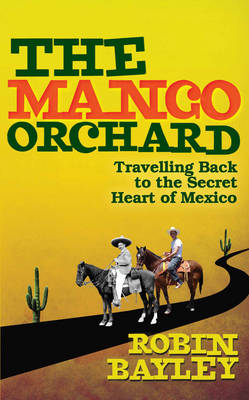
Book Review: The Mango Orchard by Robin Bayley


I remember the first time I had the feeling that somewhere, something was waiting for me, in a land I didn’t yet know.

So begins The Mango Orchard, Robin Bayley’s enthralling travel writing come family history adventure. At its heart lies an appreciation of the power of stories and storytelling. As a boy, Robin had listened enthralled as his grandmother told tales of Mexican adventures at the beginning of the twentieth century; of her father, Arthur ‘Arturo’ Greenhalgh, and his run-ins with bandits, bags of silver left beside a mango tree, and a narrow escape from the Mexican revolution. Like the best stories, these opened up new worlds of possibility to Robin, and posed unanswered questions. Were those bags of silver still there, hidden in the trunk of a mango tree? If Arturo had left in such a hurry, he must have left something of himself behind.

These stories stayed with him as he grew up and, when the opportunity of voluntary redundancy presented itself, he set out to follow in the footsteps of his great grandfather and discover the truth for himself. The Mango Orchard is a record of those travels, and the amazing discovery he makes in a small village in western Mexico. And soon the stories are turning full circle, driving new adventures, some even more amazing than the ones that started it all off.

The Mango Orchard is a compelling and readable tale that warms the heart and reminds us of the common humanity we share the world over. Bayley tells his parallel stories with wit and wide-eyed sense of adventure. He possesses an ear for dialogue and his writing captures the sounds and flavours of Latin American Spanish in a way that is easy to digest, yet gives the impression of being there in the midst of other languages and cultures.

The differences in culture are elucidated without Bayley needed to consciously express them; they come through in every word he writes, and in the situations he finds himself in. As he travels through New York, Guatemala, Colombia, and Venezuela, on route to Mexico, he encounters a series of situations and characters whose own stories and lives threaten to divert him from his quest. There’s the archetypal South American hotel that rents rooms to couples by the hour, and to tourists too poor to afford anywhere else by the night, in which Bayley finds himself lying awake to the sound of gunshot outside and a body landing on the roof above. There’s a wild drive in a ramshackle car that needs running repairs on a regular basis; a beautiful and mysterious Guatemalan girl with seemingly mystical powers. Families take him in with astounding generosity that is unimaginable in the UK.

But he presses on, and suddenly the mystery resolves itself. Towards the end, a conversation takes place between Robin Bayley, and one of his newly found relatives:

‘You know,’ I say, my arm round his shoulder, ‘the fantastic thing about being here is not only that you are all family, but that you’re all such great people too.’
‘Yes, but somos familia.’ We’re family.
‘I know that, but what I’m trying to say is that as well as that, you’re Buena gente.’ Good people.
He shakes his head in incomprehension. ‘Somos familia.’
Finally I see his point. We are family, punto. Nothing else matters.

More than anything else, this dialogue sums up the amazing journey of discovery that makes up The Mango Orchard. What is family? What does it mean to have a family? And how far will you travel in search of a family. These are the questions that are raised on every page, and tied throughout are the stories these families tell.


At times, character development is a bit slight and there are depths of the story that are not mined as fully as one might like. The critical reader may feel they wanted more background on events and clearer explanations of some of the events that take place, particularly surrounding Arturo's involvement in the Revolution. However, these are minor concerns and the overriding impression of The Mango Orchard is as a compelling and heartfelt expedition, a powerful case for valuing stories and storytelling,  and an amazing tale that demonstrates that the truth is often far stranger and more rewarding than fiction.

The Mango Orchard was first published by Preface, an imprint of Random House, in 2010. Edition shown is this first Hardback edition, which has since been replaced by a paperback version, published by Arrow Books, another imprint of Random House, in 2011. ISBN (HB) 9781848092235, (PB) 9781848092242. 303pp

Thursday, 4 March 2010

Book Review: Geek Love - Katherine Dunn


To celebrate the 200th review on Books, Time, and Silence, I am re-posting 10 of my favourite reviews.

On this final morning I’m taking a step into the bizarre with Katherine Dunn’s Geek Love.

Read: January 2008

Geek Love in one tweet-sized chunk:
Giving new meaning to the term ‘nuclear family’, Geek Love is defined not by its freak-show setting, but the common humanity inherent within.

“'When your mama was a geek, my dreamlets’, Papa would say, ‘she made the nipping off of noggins such a crystal mystery that the hens themselves yearned toward her, waltzing around, hypnotised with longing.”

Despite its freak show characters and setting, Geek Love is one of the most tender-hearted novels you could hope to read. It works because at no point is it sick, grotesque, tasteless or glibly shocking. Katherine Dunn’s talent is in making this very remarkable story feel like the most natural thing in the world. And it is. Because Geek Love is a novel about families, and individuals within families, and the crazy world which exists outside them.

Narrated by Olympia, a bald, hunchback, albino, dwarf, Geek Love tells the story of the Binewski family, and their rise to fame. For Al and Lil Binewski have grander plans than circus geeking for their Binewski Fabulon troupe. Together they hit upon the idea of breeding their own freak show. So during each pregnancy Lil guzzles drugs and pesticides, douses herself in radiation, all in the hope of producing freaks compelling and original enough to keep the circus afloat. Giving new meaning to the term ‘nuclear family,’ Lil gives birth to 5 living children, each fantastic in their own unique way. First out comes the limbless Arturo, Aqua Boy, megalomaniac, entertainer, preacher and eventually, cult leader. He is followed by the musically talented Siamese twins Electra and Iphigenia, beautiful and alluring and each as individual as they are united. The Lizard Girl comes third, green tinted and with one tail shaped leg but she dies suddenly and mysteriously aged 2. And then there is Olympia, unremarkable, unprofitable, who sleeps under the sink. Finally comes Fortunato, almost rejected for his apparent normality, he turns out to possess strange telekinetic powers and an angelic temperament. Led by this motley crew of performers, the circus grows beyond all recognition, raking in audiences in ever greater numbers.

But as within any family there are internal tensions, people pulling in opposite directions, and Arturo will not quit until the whole family is subjected to his twisted, power-crazed ways.

Most characters in novels act as personified ideas, or plot developers. It is rare to find a family whose entire dynamic just exists, naturally and without pretence. And it is all the more remarkable since the characters in question are, physically at least, far from the norm.

With a constantly evolving plot, complex and engaging characters and easily readable style, Geek Love is a book to become thoroughly engrossed in. The characters are as fabulously drawn as any I have read, equal even to those in Donna Tartt’s The Secret History. They each inhabit their own skin and minds completely, think independently and diversely. You can almost picture their bodies in the shape of the words, living, breathing, dreaming, loving, hating. From the cold-hearted, vindictive sneer of Arturo to the loving honesty of Fortunato, the independent personalities of the twins and the unrequited love of Olympia, it is impossible not to love them all. Love them because in each of them lies that spark of recognisable complex humanity that is so rarely found in literature.

The whole basis of Geek Love is the inversion of society’s view of physical perfection. Despite their external differences the Binewski children do not grow up shunted, embarrassed or gawked at. They are treasured, worshipped, made special by their different forms. Al refers to them as his ‘rose garden’ his little ‘dreamlets’. They look down upon the ‘norms,’ pity all those whose bodies are unremarkable and whose lives are so much harder because of it. Indeed, their hierarchy is based upon the scale of abnormality, a scale in which Olympia is considered the lowest and Arturo the highest form of creation.

Geek Love doesn’t warn against judging character by its skin. It is not as simple as that. Rather it gets under that skin, into the life and mindset of its characters, rejecting the very notion of physical normality. Utterly original, it is a cult piece of literature which deserves to be read even more widely than it currently is.


8.5 out of 10